Argalasti Argalasti
 |
The lush village of Argalasti is encountered when traveling toward southern Pelion. It is an ideal destination for nature lovers, as it is a region with endless natural beauty. Additionally, it offers a variety of sports activities such as horseback riding and hiking along trails through the green mountainous landscape of Pelion.
Argalasti constitutes a municipality and consists of three municipal districts: Argalasti, Xinovrysi, and Metochi. It borders the Municipality of Afetai to the north and the Municipality of Sipiados to the south, while to the east and west lie the Aegean Sea and the Pagasitic Gulf, respectively.
A characteristic feature of the area is the many olive groves, which follow the forested zones. The traditional settlements extend from the coastal to the semi-mountainous areas and are notable for preserving the character of Pelion architecture.
During your stay in Argalasti, it is worth visiting some of the area’s attractions, such as the traditional stone bridges, fountains, churches, and monasteries.
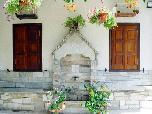
Of particular interest are the stone arch bridges, which are unique examples of the architecture of Epirus craftsmen. Also noteworthy are the numerous fountains found in all settlements of the Argalasti municipality, which have historical significance due to the inscriptions they bear. Among them, the Koeni, Agios Ioannis Theologos, Lefokastro, and Kouvlos fountains stand out.
The hallmark of Argalasti is the bell tower of the Holy Church of the Holy Apostles, built in the early twentieth century. It is an exact replica of the bell tower of Agia Fotini in Smyrna, which collapsed in 1950.
And of course, do not miss visiting the historic Monastery of Agios Nikolaos. Founded in 1732, its interior contains remarkable frescoes dating from the late 18th century. It is better known as the Monastery of Paou because it is built in the beautiful location of Paou, just 2 km southwest of Argalasti.
|
|



 Greek
Greek  English






 Map
Map