Dodoni Dodoni
 |
In the Dodoni region, there is one of the most important archaeological sites in the Ioannina prefecture and more broadly in Epirus. It is located 22 km south of the city of Ioannina. According to historical records, Dodoni is considered the cradle of the Greek-speaking tribes.
It occupies an area of extraordinary natural beauty. The combination of the valley’s natural charm with the wild majesty of the surrounding mountains creates images of unique aesthetics, while the sense of sacredness of the site makes exploring the area a breathtaking experience.
The municipality of Dodoni consists of nine communities and six settlements. Agia Anastasia, Dragopsa, Dramesi, Dodoni, Kostanian, the Oracle, Meliggoi, Polygyros, and Psina and its settlements spread across the slopes of Mount Tomaros and embrace the valley of ancient Dodoni. Each community and settlement has its own noteworthy history over time.
Through the centuries, Dodoni has managed to preserve all the charm of the myths surrounding it. Today, with the grandeur of its past, its natural beauty, and its residents striving for the best, it moves confidently into the future.
Getting to know the Archaeological Site of Dodoni
The archaeological site of Dodoni lies in the narrow valley between Tomaros and Manoliasa. It is one of the most important archaeological sites in Greece, as this area was the starting point for Greek-speaking tribes. According to historical records, the first Greeks, the “Selloi,” lived and developed their culture here.
Dodoni marks the beginning of the history of Epirus. Visitors to the archaeological site of Dodoni will have the opportunity to see the oldest and one of the most important oracles. Also, the largest ancient theater, the Bouleuterion, the Prytaneion, and the Stadium, which surround the ancient sanctuary.
Initially, this area was dedicated to the worship of the Earth goddess. The worship of Zeus and Dryos was introduced to Dodoni by a branch of the Thesprotians, the Selloi, during the 19th–14th centuries BCE and quickly became the dominant cult. The first offerings from southern Greece appeared at the end of the 8th century BCE.
The beginning of construction activity in the area is dated to the 4th century BCE. The sanctuary flourished in the 3rd century BCE. The sanctuary was destroyed in 219 BCE by the Aetolians but was rebuilt and continued to operate until the Roman intervention and its destruction in 167 BCE. The sanctuary functioned in a different manner during Roman times. In the 4th century CE, under Theodosius the Great, the sanctuary permanently ceased to operate.
During the period of barbarian invasions, the area seems to have been abandoned due to Slavic raids. Later, it followed the common fate of the Byzantine Empire. It was part of the Despotate of Epirus and eventually fell under the rule of the Ottoman conquerors. It was liberated in 1913 along with the rest of Epirus.
The Oracle of Dodoni
The Oracle of Dodoni is the oldest and one of the most important oracles. Initially, the Great Goddess, the deity of fertility and prosperity, was worshiped there. Later, this worship was replaced by that of Dodonaean Zeus. It is said that the sanctuary took its name from the wife of Zeus, Dione, which meant “giver of life.” The sanctuary was open-air, and it was believed that Zeus resided in the roots of the sacred oak at the entrance of the holy site. Around the sanctuary were bronze tripods, from which the priests delivered the oracles.
The Pelasgians consulted this oracle regarding the names of their gods. The oracle is also mentioned by Herodotus in the Argonautic expedition.
One of the features of the oracle’s importance was its ability to attract southern Greeks, who considered it a “Greek oasis in a barbaric desert.”
As it was a religious center in antiquity, over time, other temples were built in the area, such as the temples of Heracles, Dione, Themis, and Aphrodite.
Monuments of the Archaeological Site of Dodoni
At the end of the 4th century BCE, the administrative center of the Epirotes began to develop in the Dodoni area. At that time, several important buildings were constructed, parts of which survive to this day. Specifically:
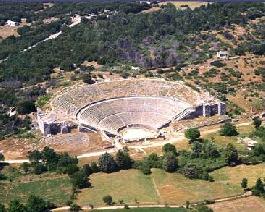
The Ancient Theater of Dodoni was built in the 3rd century BCE by King Pyrrhus. It is the largest ancient theater in Greece, with a capacity of approximately 18,000 spectators. Its main parts were the koilon, the orchestra, the Doric stoa, and the wooden stage. It was destroyed in 219 BCE by the Aetolians. At the end of the 3rd century BCE, it was restored and completed. It was destroyed in 167 BCE by Aemilius Paulus. In the 1st century BCE, it functioned as an arena. Today, during the summer months, festivals featuring mainly works of classical authors take place in the ancient theater.
The Bouleuterion was constructed at the end of the 4th or the beginning of the 3rd century BCE. It consists of a hall measuring 43.60 x 32.35 m and a Doric stoa at the front. It was rebuilt after being burned by the Aetolians in 219 BCE and after the destruction by the Romans (167 BCE). It was repaired under Augustus and operated until the late 1st century BCE.
The Prytaneion is a rectangular building constructed in the 4th century BCE, measuring 17.30 x 10.70 m. It is the oldest building in the Dodoni archaeological site after the oracle. It served as accommodation for the priests of Zeus or the leaders of the Molossian League. It was destroyed in 219 BCE by the Aetolians.
The Acropolis is located at the top of the hill and is surrounded by a polygonal wall from the 4th century BCE with a perimeter of about 750 m. The wall is reinforced in places with rectangular towers. Three gates are visible. Inside the wall, foundations of buildings and an underground water cistern carved into the rock can be seen.
The Stadium, which is one of the few ancient stadiums with stone seats, has 21 or 22 rows. It dates to the second construction phase of the ancient theater, i.e., the late 3rd century BCE. The stadium has not been fully excavated.
|
|



 Greek
Greek  English





 Map
Map