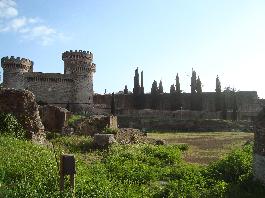
Tivoli unfolds just east of Rome, where the land begins to rise and the air grows cooler, offering a sense of distance from the capital without losing its historical depth. Perched above the Aniene River, the town is defined by water, stone, and an enduring relationship with landscape that has attracted visitors since antiquity.
Its identity is inseparable from its villas, each expressing a different vision of beauty and power. Villa d’Este is renowned for its elaborate gardens and fountains, where water is transformed into movement and sound, creating a setting that feels both theatrical and serene. Nearby, Hadrian’s Villa spreads across a vast area, a complex of ruins that reflects the scale and imagination of the Roman Empire, blending architecture with the surrounding terrain.
The town itself is compact and layered, with narrow streets, quiet squares, and viewpoints that open suddenly onto deep valleys and cascading greenery. The constant presence of water—flowing, falling, echoing—gives Tivoli a dynamic quality, contrasting with the stillness of its stone buildings.
What distinguishes Tivoli is this interplay between nature and design. It is a place where human creativity has long engaged with the natural environment, not to dominate it, but to shape it into something expressive and enduring. The result is an atmosphere that feels both cultivated and organic, where history, landscape, and sensory experience come together in a uniquely harmonious way. |
| Add Review [Reviews Guidelines] |
| Only registered Holiday members may write reviews. Register. |



 Greek
Greek  English