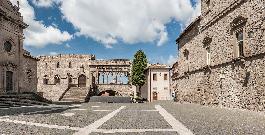
Viterbo stands with a quiet authority in northern Lazio, its medieval character preserved with unusual completeness. Encircled by ancient walls and towers, the town carries the weight of its past without losing a sense of everyday life. The historic quarter, San Pellegrino, is one of the best-preserved medieval districts in Italy, where stone houses, external staircases, and narrow passageways create a dense, textured landscape that feels both intimate and enduring.
The town’s identity is closely tied to its period as a papal seat in the 13th century, a legacy still visible in the austere yet imposing Palazzo dei Papi. Nearby, the cathedral rises with a restrained elegance, anchoring a skyline that remains largely unchanged for centuries. Unlike more polished destinations, Viterbo retains a certain roughness—weathered surfaces, muted tones, and quiet corners that reveal themselves slowly.
Beyond its architecture, Viterbo is defined by water and earth. Natural hot springs lie just outside the walls, their steaming pools offering a contrast to the cool stone of the town. The surrounding countryside, shaped by volcanic origins, stretches into a patchwork of fields, forests, and small villages, reinforcing a sense of connection between the urban and the natural.
What makes Viterbo distinctive is its authenticity. It does not present itself as a spectacle, but as a place that has continued to live within its history. The experience is one of immersion rather than observation, where the rhythm of the past and present coexist in a way that feels grounded, unforced, and quietly compelling. |
| Add Review [Reviews Guidelines] |
| Only registered Holiday members may write reviews. Register. |



 Greek
Greek  English