Fiumicino lies along the western edge of Rome, where the Tiber River meets the Tyrrhenian Sea. Known primarily as a point of arrival due to the nearby airport, the town itself has a distinct identity shaped by water, movement, and a strong connection to fishing traditions.
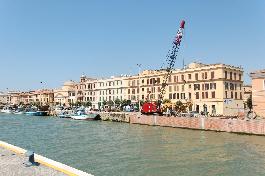
The canal running through Fiumicino forms its central axis, lined with restaurants, small boats, and working docks that give the area a practical, maritime atmosphere. Fishing remains an active part of daily life, and the presence of the sea is immediate—not as a distant view, but as an integral part of the town’s structure and routine.
Along the coastline, wide sandy beaches extend outward, offering a more open and expansive setting compared to the dense urban fabric of nearby Rome. The horizon feels broad and uninterrupted, with shifting light reflecting off the water and sky. The transition from city to coast is gradual, yet clearly defined by the change in pace and environment.
Fiumicino’s streets are functional and modern, with less emphasis on historical layering and more on everyday use. Yet traces of the past remain in archaeological areas and older quarters, hinting at the long history of settlement around the mouth of the Tiber.
The town operates as both a gateway and a destination, balancing transient movement with local continuity. Travelers pass through, while residents maintain a steady rhythm shaped by the sea, the river, and the flow of people.
Fiumicino is defined by transition—between land and water, arrival and departure, urban proximity and coastal openness. It offers a different perspective on Italy, where the experience is less about monuments and more about atmosphere, movement, and the quiet persistence of daily life by the sea. |
| Add Review [Reviews Guidelines] |
| Only registered Holiday members may write reviews. Register. |



 Greek
Greek  English