Pietrasanta lies between the foothills of the Apuan Alps and the nearby coast of the Tyrrhenian Sea, creating a setting where mountains, art, and seaside influence converge. Though close to the beaches of Versilia, the town itself feels inward-looking, defined more by creativity and craftsmanship than by coastal tourism.
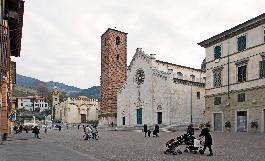
At its center is the elegant Piazza del Duomo, a refined open space framed by cafés, galleries, and historic buildings. Overlooking it is the Cathedral of San Martino, whose simple façade contrasts with the lively artistic energy that fills the square. Sculptures—both classical and contemporary—often appear throughout the town, reflecting its long-standing role as a center for marble working.
Pietrasanta has deep ties to the nearby marble quarries of the Apuan Alps, the same source of stone used for centuries by renowned artists. This connection has shaped the town into a hub for sculptors and artisans, where workshops and studios remain active, and the process of creation is still visible. The presence of art is not confined to galleries; it extends into the streets, blending with daily life.
The historic center is compact and carefully preserved, with narrow streets that open into small courtyards and quiet corners. There is a sense of balance between tradition and modern expression, where centuries-old craftsmanship coexists with contemporary artistic experimentation.
Beyond the town, the landscape shifts quickly—from the vertical lines of the mountains to the flat, open coastline. This proximity to contrasting environments gives Pietrasanta a dynamic character, even as its pace remains calm and deliberate.
Pietrasanta is defined by its relationship with material and form. It is a place where stone becomes art, where the act of making is part of the atmosphere, and where the surrounding landscape continues to influence both the identity and the creativity of the town. |
| Add Review [Reviews Guidelines] |
| Only registered Holiday members may write reviews. Register. |



 Greek
Greek  English