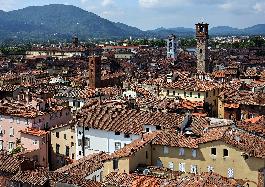
Lucca rests in the plains of northwestern Tuscany, enclosed almost entirely by its intact Renaissance walls, which form one of the most distinctive and defining features of the city. These broad, tree-lined ramparts encircle the historic center like a protective ring, now serving as a raised promenade where people walk, cycle, and pause above the streets below.
Inside the walls, Lucca unfolds as a calm and cohesive network of narrow streets, small piazzas, and well-preserved buildings. The atmosphere is measured and unhurried, with a sense of balance between architectural beauty and everyday life. At the heart of the city lies the Piazza dell'Anfiteatro, an oval-shaped square built on the remains of a Roman amphitheater, its curved form still clearly visible in the arrangement of surrounding buildings.
Lucca’s churches add further depth to its character. The San Michele in Foro stands on what was once the Roman forum, its ornate façade rising above the square with a sense of vertical elegance. Nearby, the Lucca Cathedral reflects a blend of styles, housing works of art that connect the city to broader currents of Italian history.
One of Lucca’s most recognizable features is the Guinigi Tower, topped by a small grove of trees that grows improbably high above the rooftops. From its summit, the view reveals the orderly layout of the city within its walls and the open countryside beyond.
Lucca feels self-contained, almost insulated from the outside world. The walls create not just a physical boundary but a psychological one, shaping a space where time seems to move differently. It is a city defined by continuity and preservation, where the past is not isolated but fully integrated into the present, creating an environment that feels both intimate and enduring.Lucca rests in the plains of northwestern Tuscany, enclosed almost entirely by its intact Renaissance walls, which form one of the most distinctive and defining features of the city. These broad, tree-lined ramparts encircle the historic center like a protective ring, now serving as a raised promenade where people walk, cycle, and pause above the streets below.
Inside the walls, Lucca unfolds as a calm and cohesive network of narrow streets, small piazzas, and well-preserved buildings. The atmosphere is measured and unhurried, with a sense of balance between architectural beauty and everyday life. At the heart of the city lies the Piazza dell'Anfiteatro, an oval-shaped square built on the remains of a Roman amphitheater, its curved form still clearly visible in the arrangement of surrounding buildings.
Lucca’s churches add further depth to its character. The San Michele in Foro stands on what was once the Roman forum, its ornate façade rising above the square with a sense of vertical elegance. Nearby, the Lucca Cathedral reflects a blend of styles, housing works of art that connect the city to broader currents of Italian history.
One of Lucca’s most recognizable features is the Guinigi Tower, topped by a small grove of trees that grows improbably high above the rooftops. From its summit, the view reveals the orderly layout of the city within its walls and the open countryside beyond.
Lucca feels self-contained, almost insulated from the outside world. The walls create not just a physical boundary but a psychological one, shaping a space where time seems to move differently. It is a city defined by continuity and preservation, where the past is not isolated but fully integrated into the present, creating an environment that feels both intimate and enduring. |
| Add Review [Reviews Guidelines] |
| Only registered Holiday members may write reviews. Register. |



 Greek
Greek  English