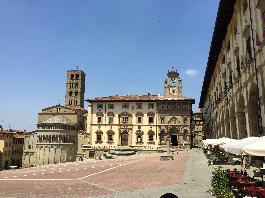
Arezzo sits slightly apart from the main flow of Tuscan tourism, positioned on a gentle hilltop in eastern Tuscany. This distance from the more frequented routes gives it a quieter, more introspective character, where history feels embedded in daily life rather than displayed for it.
The city unfolds with a subtle irregularity, its streets sloping and converging toward the striking Piazza Grande. This wide, angled square is framed by a mix of medieval and Renaissance buildings, creating a sense of layered time rather than uniform design. It is a space that feels both open and enclosed, where the architectural edges guide the eye without fully containing it.
Arezzo has long been associated with art and craftsmanship. The Basilica of San Francesco houses the celebrated fresco cycle by Piero della Francesca, a work that quietly reshaped the language of Renaissance painting through its use of perspective and light. Elsewhere, antique shops and workshops reflect a continuing tradition of skilled manual work, particularly in goldsmithing.
The city’s atmosphere is calm but not static. Markets, small cafés, and local routines bring movement to its historic setting, while the surrounding countryside—less dramatic than other parts of Tuscany—extends outward in gentle patterns of fields and low hills.
Unlike destinations built around a single defining image, Arezzo reveals itself through details: the texture of stone, the play of light across uneven streets, the coexistence of artistic heritage and ordinary life. It offers a more measured and reflective experience, where the depth of history is present but never overwhelming, and where the pace allows for observation rather than spectacle. |
| Add Review [Reviews Guidelines] |
| Only registered Holiday members may write reviews. Register. |



 Greek
Greek  English