Trikala town Trikala town
 |
Trikala is the capital of the eponymous regional unit and the seat of the Trikkaion Municipality, occupying the northwestern part of the Thessalian plain. It is located 330 km from Athens and 214 km from Thessaloniki.
Trikala is a modern city that still retains its traditional charm. It is known for its well-planned streets, wide and straight avenues, squares, and parks, which give the city a unique beauty.
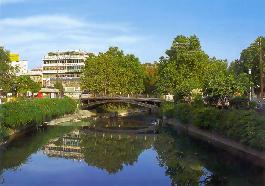
The city is built at the foothills of the last mountain range descending from Chasia toward the Thessalian plain. It is crossed by the tributary of the Pineios River, the Litheos River, which adds a special charm to the city. In recent years, the riverbed passing through the city has been landscaped and decorated with ornamental plants. The Litheos is known since ancient times and is mentioned by classical authors. According to mythology, Litheos was the son of Lethe, and according to the ancient geographer Strabo, Asclepius, the god of medicine, was born on its banks, where his sanctuary, the Asclepieion, was located.
A brief history of Trikala
Trikala is a city with a long and dynamic history. Its picturesque neighborhoods, narrow streets, and traditional rural settlements offer visitors a glimpse into the rich past of the region. Human presence in the area dates back to the Middle Paleolithic era. In antiquity, the city was known as Trikka, Trikke, or Trikkai, mentioned by Homer in the Iliad. According to mythology, Trikke was named after the nymph Trikke, daughter of the Pineios River.
Trikke participated in the Trojan War, led by Asclepius’ sons, Machaon and Podaleirius, who were renowned physicians. The name Trikala first appears in 1082–1083, during the Norman conquest. Administratively, Trikke belonged to Estiaiotida, one of the four Thessalian districts.
During the Byzantine era, the city fell into decline and suffered multiple invasions. In 1395, Trikala came under Ottoman rule, lasting until 1881, when Thessaly joined the Greek state. In April 1941, it was occupied by German forces, and it was liberated in October 1944.
Major historical monuments
While visiting Trikala, besides exploring the traditional villages of the region, it is worth seeing the city’s landmarks that reflect its rich history. Among them is the Asclepieion of Trikke. The archaeological site, located near the Metropolitan Church of Saint Nicholas, is fenced and open to visitors. Excavations over time, including those by archaeologist P. Kastriotis in 1902, revealed parts of the Roman baths. Today, visitors can see: (a) a Hellenistic building used also in Roman times, with mosaic floors, (b) a Hellenistic stoa, (c) a Roman bath, and (d) a post-Byzantine church.
On the northern side of Trikala, near the Antichasia Mountains, stands the Byzantine Fortress, believed to have been built in the classical era and renovated many times, including by Emperor Justinian in the 6th century. The Ottomans repaired it in the 17th century and added a large clock on its eastern side. In 1936, a 33-meter clock was built on its base. Today, the fortress houses an open-air theater, a municipal kiosk, a restaurant, and a café.
Along the eastern side of the fortress stretches the traditional neighborhood of Varousi, which was the aristocratic district of Trikala between 1900–1930. Varousi is known for its narrow streets and houses dating from the 17th to 19th centuries, built mainly of wood and reed, with brick infill and painted in various colors. Many houses feature “sachnisia”, enclosed overhanging spaces. Varousi is home to the city’s oldest churches, mostly from the late Byzantine period. Its streets inspired famous songs, including Vassilis Tsitsanis’ classic: “In Trikala, in the two narrow streets, they killed Sakaflias…”. According to local legend, Sakaflias was a real figure, a charming bohemian of the interwar period whose life and dramatic death became part of folklore, earning Trikala residents the nickname “Sakafliades.”
Plan a visit to the Municipal Folklore Museum of Trikala, which houses a remarkable collection from the early 19th century to 1930, including traditional costumes, handmade textiles, household and professional tools made of clay, wood, and metal, and old photographs.
The Osman Shah (Koursoum) Mosque, built in the mid-16th century, stands at the southern entrance of the city. Osman Shah Bey, son of Mustafa Pasha, constructed it while exiled in Trikala. The mosque features an 18-meter lead-covered dome, with walls of alternating layers of stone and red bricks. It was restored in 1996 by the Municipality of Trikala with funding from the European Union and is recognized as a UNESCO-protected monument.
In the northern part of the city, beyond the fortress, is the Prophet Elias Hill, covered with pine trees. At its highest point stands a cross-shaped chapel dedicated to Prophet Elias, dating from 1896. The hill also hosts Trikala’s zoological park, spanning 30 acres and home to a wide variety of animals, including tigers, ostriches, emus, ponies, deer, vultures, pheasants, partridges, domestic ducks and geese, parrots, chinchillas, iguanas, snakes, and exotic birds. The park is a popular destination year-round. Visitors can relax afterward at the hill’s Tourist Kiosk.
Trikala is a vibrant modern city where visitors can find a variety of entertainment options. The nightlife is especially lively along Asklipiou pedestrian street, in the city center, and in the narrow streets of Manavika, where most bars and nightclubs are located.
|
|
|



 Greek
Greek  English





 Map
Map