Piraeus Piraeus
 |
Piraeus is a city with a unique history. From ancient times to the present, it has played a leading role in the historical events of Greece. Its historical journey is closely linked to the sea, to which it owes its economic and cultural development.
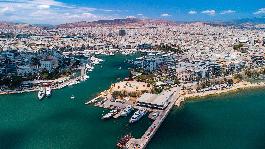
It is located northwest of Athens, 10 km from the city center, and lies on the Saronic Gulf. It is a peninsula surrounded by the sea (geologically, it is believed to have been an island in ancient times) and has three ports (the central port, Mikrolimano, and Marina Zeas). From ancient times to the present, Piraeus has “served” Athens as its port and played an important role in the city’s defense. During the Persian Wars, it was the harbor of the warships of the Athenian general Themistocles. In 86 B.C., it was completely destroyed by the Romans. In the Middle Ages, it was called Porto Leone, named after the marble statue of the lion that stood at the entrance of the port. This symbol of the port was stolen during Morosini’s campaign and transferred to Venice. Today, a replica of this lion has been placed in the port.
In 1834, it was chosen as the central commercial port of Athens. Since then, it has been renovated several times to meet the needs and modern requirements of the time. It is one of the largest and most important ports in the Mediterranean.
From the port of Piraeus, all ferry lines to the Greek islands and foreign ports depart.
Access to the port is very easy, as the Electric Railway station (Piraeus – Kifisia line) is located opposite its entrance, along with many bus terminals connecting the port to central Athens and other areas of Piraeus.
The intense pace of life around the port is immediately noticeable. People move back and forth, and the shops around it buzz with commercial activity.
Undoubtedly, the heart of Piraeus beats at the port. However, the city itself is also of interest. A walk through Piraeus’ picturesque neighborhoods, along the central streets with heavy traffic, and its timeless youth hangouts – and not only – reveals the beauty of this multifaceted city.
It is a densely populated city, often chaotically built in some areas, much like Athens. But the saltiness of the sea, combined with the area’s centuries-old history that has endowed it with a unique charm and glamour, has made Piraeus a muse for many artists. Dozens of songs have been written about it and became huge hits. Greek films have been shot in its picturesque neighborhoods and the port, capturing the lifestyle of Piraeus’ inhabitants.
Today, Piraeus has all the characteristics of a modern city, while also retaining the features of a major maritime, commercial, and industrial center.
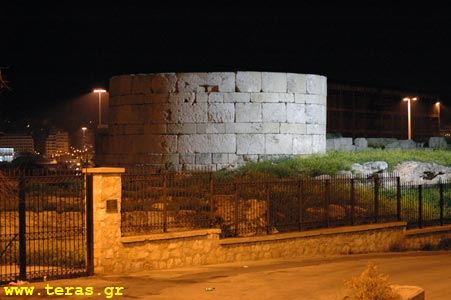
Among the city’s landmarks are the neoclassical buildings found in several central locations, the famous Municipal Theater dominating Korai Square, the Municipal Art Gallery, the Archaeological and Naval Museums, the Themistoclean Walls, the Tunnel (Paraskevas Cave), the Veakeio Theater, and other sites that combine traditional and modern architectural elements.
Some of the busiest areas of Piraeus are Mikrolimano (formerly called Tourkolimano) and Pasalimani. In these areas, many tavernas, restaurants, cafés, and bars operate, serving as hangouts for both young people and older visitors. Especially during the summer, when the sea attracts crowds like a magnet, Piraeus becomes a central spot for entertainment for the residents of the capital.
|
|



 Greek
Greek  English






 360 PANORAMAS







 Map
Map