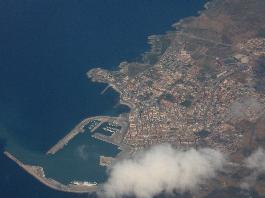
Porto Torres stands on the northwestern coast of Sardinia, facing the open waters of the Gulf of Asinara. It is a place where layers of history meet a working maritime identity, shaped as much by its ancient past as by its role as a modern port.
The town’s origins reach back to Roman times, when it was known as Turris Libisonis, one of the island’s most important settlements. Traces of this era remain visible, particularly in the Basilica of San Gavino, a massive and austere structure built from local stone, whose simplicity and scale reflect early medieval influences rooted in an even older past.
The waterfront defines much of Porto Torres today. Ferries and cargo ships connect the town to mainland Italy and beyond, giving the harbor a sense of constant movement and purpose. This functional aspect shapes the atmosphere—less romanticized than other coastal destinations, yet grounded in real activity and continuity.
Nearby, the coastline opens into quieter, more natural spaces, with beaches and rocky stretches that contrast with the industrial edge of the port. Just offshore lies the island of Asinara, a protected area known for its wild landscapes and clear waters, visible from the mainland as a low, elongated silhouette.
The town itself is straightforward in its layout, with broad streets and residential areas that reflect modern development alongside historical fragments. Daily life feels practical and direct, with a strong connection to the sea still evident in local routines.
Porto Torres does not present a polished image. Instead, it offers a more complex perspective—where ancient foundations, maritime function, and natural surroundings coexist. It is a place defined by transition and endurance, where the past is present but not preserved for display, and where the sea continues to shape both identity and purpose. |
| Add Review [Reviews Guidelines] |
| Only registered Holiday members may write reviews. Register. |



 Greek
Greek  English