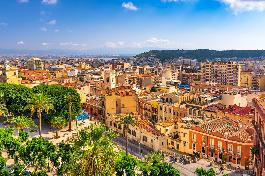
Cagliari spreads across a series of low hills overlooking the southern coast of Sardinia, facing the open expanse of the Gulf of Cagliari. Its position gives the city a layered structure, where historic districts rise above the harbor and modern life unfolds closer to the waterfront.
At the top sits Castello, the old fortified quarter, defined by high walls, narrow streets, and panoramic terraces. From here, the view extends across the sea, salt flats, and distant mountains, creating a sense of openness that contrasts with the enclosed, stone-built alleys. Landmarks like the Cagliari Cathedral reflect centuries of changing influences, blending styles and histories into a single structure that anchors the district.
Descending toward the lower parts of the city, the atmosphere shifts. Marina and Stampace are more immediate and lived-in, with busy streets, markets, and a steady flow of daily activity. The port area connects Cagliari to the wider Mediterranean, reinforcing its long-standing role as a crossroads of cultures and trade.
One of the city’s defining natural features lies just beyond the urban core: the Molentargius-Saline Regional Park, where shallow lagoons and salt pans attract birdlife, including flamingos that move gracefully through the landscape. This unexpected presence of wildlife so close to the city adds another dimension to Cagliari’s identity.
The coastline nearby offers long stretches of pale sand and clear water, with Poetto Beach extending for several kilometers. Here, the mood becomes more relaxed and expansive, with sea and sky dominating the scene.
Cagliari is defined by contrast and elevation—between historic and modern, land and water, density and openness. It presents a version of Sardinia that is both urban and elemental, where history, daily life, and natural surroundings coexist in a dynamic and continuous flow. |
| Add Review [Reviews Guidelines] |
| Only registered Holiday members may write reviews. Register. |



 Greek
Greek  English