EMILIA-ROMANA EMILIA-ROMANA
 |
|
EMILIA-ROMANA AREAS
+
RIMINI
|
Emilia-Romagna stretches across northern Italy from the Adriatic coast to the gentle rise of the Apennines, offering a landscape that is orderly, fertile, and deeply connected to tradition. It is a region where efficiency and richness coexist, shaped as much by agriculture and industry as by culture and history.
The land itself is broad and productive. Much of Emilia-Romagna lies within the Po Valley, where flat plains extend outward in a patchwork of fields, farms, and small towns. This is one of Italy’s most important agricultural areas, and the sense of cultivation is visible everywhere—carefully managed land, straight roads, and a rhythm tied to seasonal cycles.
Cities here carry a strong, grounded character. In Bologna, long arcaded streets create a continuous, sheltered urban space, while medieval towers and red-brick buildings give the city a warm, cohesive tone. Elsewhere, places like Parma and Modena reflect a quieter elegance, where culture is expressed through detail rather than scale.
Food is central to the identity of Emilia-Romagna. The region is often considered the culinary heart of Italy, known for products and dishes that have become internationally recognized—yet here they remain part of everyday life, prepared with consistency and respect for tradition.
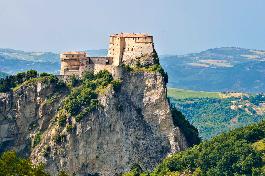
Toward the south, the terrain gradually rises into the Apennine foothills, where forests and small villages introduce a more relaxed, rural atmosphere. To the east, the Adriatic coastline adds a lighter, more open dimension, with seaside towns and long beaches that contrast with the structured inland plains.
What defines Emilia-Romagna is its sense of balance and substance. It does not rely on dramatic landscapes or singular landmarks; instead, it offers depth through continuity—of land, culture, and daily life—creating an experience that feels authentic, stable, and quietly rich. |
|



 Greek
Greek  English





 Map
Map