Santorini
 |
Author :
Anthi kontosorou Date :
24 /
2 /
2005
Cosmopolitan holidays in the shade of volcano...
|
Santorini, the particular island of Cyclades |
|
Santorini, a creation of peeved nature, due to her special history and legends that followed her, the traditional settlements and the vivid cosmic life, has conquered the whole world.
It is the southest island of Cyclades. Literally it's a complex of islands comprised from Thera, Therasia, Aspronisi, Palea and Nea Kameni. It is an island with long history that has suffered a lot of catastrophes due to volcano eruptions that have changed its shape.
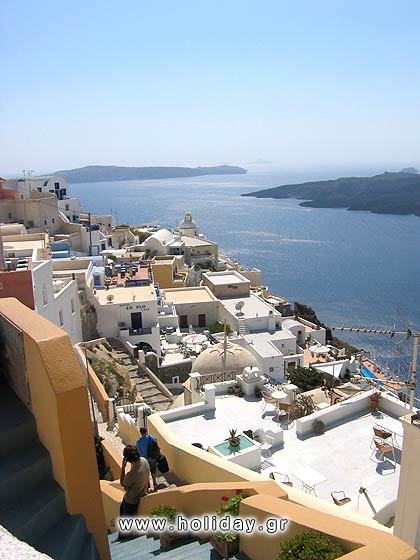
But human power turned to be stronger than rough nature. Today the -almost- lunar scenery with the black, grey and red volcanic rocks has turned into a white state. The mild architecture of Cyclades islands has changed the island's sight. The graphic villages, with the narrow cobblestone pavements, the small squares and their churches impress every visitor. View to volcano that most tourist resorts have- is spectacular. The picture is unique especially the sunset. Photos of Santorini's sunset are all around the world. At dawn all visitors run to Caldera to see the reddish sky.
|
All of Santorini is a site. The significant archaeological places (Akrotiri, Ancient Thera) the museums, the monasteries, the churches, the tenable settlements, the volcano, all pieces of a puzzle that join yesterday with today and prove how special Santorini is.
Vivid life tempos characterize Santorini. It's one of the most cosmopolitan islands in Greece with tourist development. It offers high standard services to all visitors.
As for accommodation you will find hotels and rooms to let of all categories that satisfy all demands. Concerning gastronomic delights, Santorini's cuisine is famous for its special dishes, you can accompany with the local wine. Concerning nightlife and options for entertainment Santorini satisfies all preferences.
Santorini has an airport that connects the island with Athens and most of the big cities, while in its port arrive in everyday courses ferries from Piraeus, Crete and the rest of Cyclades islands.
|
Fira: unique beauty...
|
Fira: the picturesque town |
|
One of the most beautiful cities of Greece is Fira. The capital of Santorini is built in an impressive location on the top of the abrupt rocks, in a 260m height. It was established at the end of the 18th century and it's structured according to the traditional architecture of Cyclades islands.
Fira is located 10km from Santorini's port. Touring around the city will be a thing to remember. Graphic neighborhoods, white houses, churches with blue cupolas, characterize this charming capital. In its paths of great resort you will find a lot of shops, coffeehouses and restaurants to remind you that you are in the most cosmopolitan island of Cyclades.
|
In the highest spot of the capital is located Firostefani. The last and most graphic settlement of the city that has an extraordinary view. Here you will experience one of the best sunsets in Santorini. The village has now become one of the most cosmopolitan tourist resorts. Luxurious hotels, restaurants, cafes and clubs create the ideal scenery for dreamy holidays.
|
|
Imerovigli: the traditional settlement |
|
During your tour around the island you will see the traditional settlements and the beaches of Santorini. One of the villages you have to visit is Imerovigli. It is built in a privileged location, the highest spot of kaldera, in a 300m height between Fira and Oia.
This graphic settlement is considered conserved and it’s ideal for romantic walks. The houses built according to the traditional architecture of Cyclades islands and the dreamy view from the village leave no one untouched.
In Imerovigli you will see the remains of the Enetic castle "Skaros" built by Marcus Sanoudos, used as a winepress during the Venetian rule. The path from Skaros leads to the small church of Theoskepasti that has a spectacular view to the volcanic islands Palea and Nea Kameni.
|
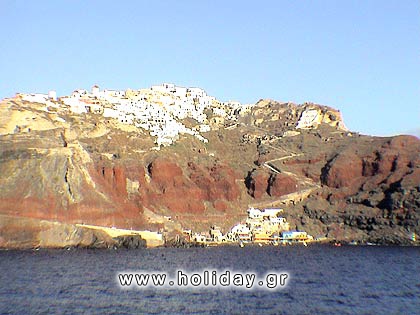
Approaching Oia, one of the most famous summer resorts you will be fascinated by the incredible beauty that lies before your eyes. It's the first settlement in Greece considered conserved. It's located in the north part of the island and it would be a pity not seeing it. Especially at dawn to see one of the most beautiful sunsets in Greece. Oia's name is connected with sunset. Every afternoon, when the horizon is painted with the colours of fire, crowds of people "hang" in caldera to see this unique spectacle. The carved in rocks settlement, house- caves, that are excavated in rocks, are its characteristic. That kind of settlement can only be found in Santorini, due to its particular type of ground.
|
One of the villages that keep the traditional feature of Cyclades islands is Vourvoulos. It is located in the northeast side of the island very close to Fira. It worths visiting the byzantine church of the village and the traditional kanaves. Its friendly people will be more than pleased to tell you the way that the famous wine of Santorini is produced. In Vourvoulos you can rest and enjoy the marvelous view to the sea and the valley.
|
|
The church at Karterados village |
|
Almost in the middle of the island is located village Karterados. One of the most beautiful and graphic villages of the inland that impresses for its special architecture. The ancient settlement is carved in rocks. The houses are built inside the bed of a dry river so that their roofs are in the same level with the street. Highly impressive are the carved in rocks churches.
|
|
Old mansion house at Mesaria |
|
The village of Messaria is located almost in the center of the island 3,5km southeastern of Fira and it's famous for its vineyards, from which is produced the biggest amount of wine in the island. Very close to Messaria is Vothonas, another village that will impress you with its traditional architecture and its curved in rocks settlement. It is worth visiting the churches of Trinity, Saint Anna, and Panagia built in 1700.
|
|
Kamari: the most famous beach of Santorini |
|
Kamari has one of the most famous beaches in the island. It distinguishes for its endless black shore, one of the biggest in the island. Thousands of people visit it every summer. It has very clear waters but deepen abruptly. We recommend you to be careful.
|
While being in Kamari you can visit the archaeological site of Ancient Thera. During ancient times Kamari was Thera's port.
The historic town of ancient Thera is located in the east side of Santorini, in Mesa Vouno. It was established in the 9th century BC by Dorian settlers. Their leader Thera gave its name to the island. According to the findings, this town was constantly inhabited until the early Byzantine times.
|
|
The monastery of Profet Ilias |
|
On the hill-side of Prophet Elia, is built the village Pyrgos, the first capital of the island. It has a glorious view, all Santorini, lies before your eyes.
Worthseeing is the monastery of Prophet Elia built on the top of the homonym hill, as well as, Theotokaki one of the oldest churches in Santorini, built in the 10th century. You will also see Kasteli the medieval castle of the island.
|
When the visitor approaches Emporio is impressed by its architecture like a fort and the narrow paths of the settlement. Among its sites distinguish the square Tower built during the period of the Turkish domination to protect people, as well as, the wealth of Saint John's monastery, from rates.
|
|
The long blank sandy beach of Perissa |
|
Haven of the region is the beach of Perissa, one of the most popular in Santorini. Its characteristic-as in the most of the island- is the black sand, creation of the volcanic eruptions. It is a well-organized beach where you can practice on water sports. There are a lot of hotels and rooms to let around the beach.
That of Perivolos follows the beach of Perisa. These two are the most famous and organized in the island. They provide all sort of comforts (sun beds, umbrellas, etc.) and the chance to practice on water sports.
|
A visit to Akrotiri will be unforgettable. Here lies one of the most important archaeological sites in Greece.It is the prehistoric settlement discovered under the volcanic ashes.
According to the findings, the settlement was inhabited since the Post Neolithic Age and flourished in the Early Copper Age. Its architectural building has a lot in common with the minoic cities. The two and three storey buildings discovered with all their household-furniture reveal the cultural level of its residents.
Life in the settlement stopped very suddenly. At the end of the 17th century BC people left the town due to strong earthquakes. The eruption of the volcano followed, that changed entirely the shape of the island. The volcanic material that covered the town and the whole island protected until our days the buildings and everything inside, just like in Pombiia.
|
Don't miss to visit the settlement of Akrotiri, built around the walls of the Venetian castle. Even today this small castle-town keeps an atmosphere of old times.
A few minutes hike from Akrotiri will take you to the famous Red Beach. An extraordinary physical phenomenon in the whole world. Huge red rocks and reddish pebbles compose an unforgettable scenery.
|
The volcano
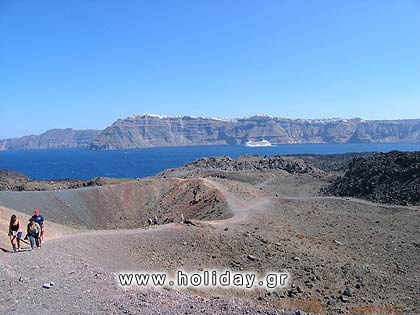
An excursion you have to schedule while being in Santorini is that to the volcano. Boats from the old port of Santorini, Skala, will take you to Nea Kameni, the island of the volcano. It is a once in a lifetime experience you can't miss. Walk around the black volcanic stones and see the crater. The smell from the brimstone is strong.
Volcano's history is connected with that of the island's. It is estimated that the first eruption occurred around 80.000BC. Because of this eruption the island of Strongili was created.
Around 1450BC the volcano erupted in the most violent way that has ever been recorded worldwide the past 10.000 years. This eruption destroyed completely the civilization of Strongili and large part of it sank in the depths of Aegean Sea. Later explosions created two smaller islands, Thirasia and Aspronisi.
There have been totally 12 large-scale eruptions during the past 200.000 in the island. The eruption in the middle of the 15th century created Mikri Kameni.
In 1707 the volcano woke up again. For five years its activity troubled the locals. The eruptions brought on the level of the sea small pieces of land from which Nea kameni was created. The island's age is not over 425 years. Some smaller eruptions and earthquakes followed in 1866 and 1925. The last activity of the volcano was recorded in 1956. Then the island suffered huge catastrophes from a severe earthquake.
|
|