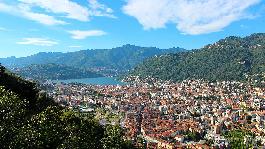
Como sits at the southern tip of Lake Como, where the Alps begin to rise and the water narrows into a deep, reflective basin. The setting is immediately striking—steep, forested hills plunge toward the lake, and elegant villas line the shoreline, their gardens descending in terraces toward the water.
The town itself blends historic character with a polished, almost refined atmosphere. Its old center is a network of orderly streets and open piazzas, anchored by landmarks like the Como Cathedral, whose intricate façade and layered architectural styles reflect centuries of craftsmanship. Nearby, the waterfront promenade offers constant views of boats drifting across the lake, with mountains framing the horizon in shifting shades of blue and green.
One of the defining experiences of Como is the relationship between land and elevation. The Funicular Como-Brunate climbs steeply from the town up to the village of Brunate, revealing expansive panoramas over the lake and surrounding peaks. From above, the geometry of the landscape becomes clear—the branching arms of the lake, the clustered towns, and the sense of depth that gives the area its distinctive atmosphere.
Life in Como moves with a quiet sophistication. Cafés spill into sunlit squares, ferries connect nearby villages, and the rhythm of the day follows the gentle movement of water and light. While it is more visited than many smaller towns in the region, it still retains moments of calm, especially in the early morning or evening when the crowds thin and the lake reflects the fading sky.
What defines Como is not just its beauty, but its balance—between natural drama and human design, between accessibility and retreat. It offers a version of northern Italy that feels composed and enduring, where every view seems carefully framed, yet entirely natural. |
| Add Review [Reviews Guidelines] |
| Only registered Holiday members may write reviews. Register. |



 Greek
Greek  English





 Map
Map