Panagia Panagia
 |
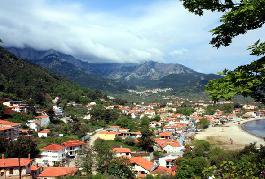
On the northeastern side of Thassos lies the traditional village of Panagia. This beautiful and picturesque settlement holds many historical secrets and has inspired numerous legends in local folklore.
The village first appears in Thassos’ history in 1445 under the name Anastasio. From the late 18th century, it is recorded as Panagia, and between 1839 and 1851, it served as the island’s capital.
The village experienced significant growth in the early 18th century, when many inhabitants from the current Limenas area of Thassos were forced to relocate to Panagia due to frequent pirate attacks on the town. Another major settlement occurred in 1770, when the Russian fleet arrived on the island. What distinguished the residents of Panagia was their deep faith and dedication to religious duties. This is reflected in the village’s name, the eleven local chapels considered miraculous, and the Church of Panagia, whose history is closely tied to that of the village. However, some historical gaps remain between the Fall of Constantinople and the late 17th century. The exact date of the church’s construction is unknown, but it is believed to predate 1821, as tradition links the village’s name to it. The church features many characteristics of Byzantine churches from Kastoria. Its iconostasis is handmade and was crafted in 1880, and inside, the icon of Panagia known as Pantavlempousa, dated 1814, stands out prominently.
Visitors to the traditional village of Panagia can enjoy the natural beauty of the area and stroll through the picturesque streets of this historic settlement.
|
|



 Greek
Greek  English





 Map
Map