Cremona lies in the flat expanses of Lombardy along the Po River, where the landscape is wide, agricultural, and uninterrupted by elevation. The setting is defined by horizontality—fields stretching outward, long sightlines, and a slow-moving river that shapes both the environment and the town’s historical development.
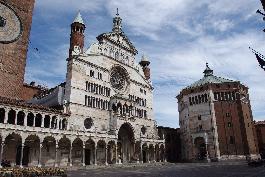
The historic center rises subtly from this plain, organized around a sequence of monumental spaces that contrast with the simplicity of the surrounding land. At its core stands the Cremona Cathedral, a large Romanesque structure with later decorative additions, whose façade and mass dominate the main square. Beside it, the Torrazzo of Cremona—one of the tallest brick bell towers in Europe—extends vertically above the otherwise low skyline, acting as a visual landmark across the flat territory.
The town’s streets are orderly and walkable, lined with arcades, historic buildings, and small workshops. Cremona is internationally known for its tradition of violin making, associated with figures like Antonio Stradivari. This craft heritage remains present in luthier workshops and institutions, giving the city a cultural identity rooted in precision, material, and sound.
Unlike more densely layered historic cities, Cremona feels open and measured. The spacing of its streets and squares reflects a balance between monumentality and accessibility, without the compression found in hill towns or fortified centers.
Beyond the urban area, the Po Valley landscape dominates—fields of crops, irrigation channels, and rural infrastructure extending in all directions. This agricultural setting reinforces the town’s grounded, practical character.
What defines Cremona is its contrast between vertical markers and horizontal context: a city that rises modestly from an expansive plain, where a few key structures anchor identity within a landscape otherwise defined by continuity and openness. |
| Add Review [Reviews Guidelines] |
| Only registered Holiday members may write reviews. Register. |



 Greek
Greek  English