Civitavecchia lies on the Tyrrhenian coast northwest of Rome, functioning primarily as a major port where movement and transit define the atmosphere more than traditional urban cohesion. It is a place oriented outward—toward sea routes, ferries, and cruise ships—rather than inward toward a dense historic core.
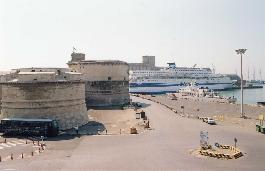
The harbor dominates the town’s identity. Protected by long piers and infrastructure, it serves as a gateway between Italy and destinations across the Mediterranean. At its edge stands the Forte Michelangelo, a Renaissance fortress that anchors the port visually and historically, marking the long-standing strategic importance of this coastal position.
Unlike many Italian towns, much of Civitavecchia was rebuilt after heavy damage during World War II, giving it a more functional and less ornate appearance. The layout is relatively open, with broad streets and modern buildings reflecting its role as a working city rather than a preserved historic destination.
Along the waterfront, promenades and public spaces provide a more relaxed dimension, where locals gather and the sea becomes part of daily life beyond its commercial function. The coastline here is less dramatic than in other parts of Italy—flatter and more industrial in places—but still defined by the constant presence of ships, water, and horizon.
The town’s connection to Rome is central to its purpose, serving as the capital’s primary maritime outlet. This relationship reinforces its identity as a point of passage, where travelers arrive, depart, and rarely remain for long.
What defines Civitavecchia is its role as an interface: between land and sea, city and transit, permanence and movement. It is less about layered beauty or historic immersion and more about function, direction, and the steady flow of people and vessels through its port. |
| Add Review [Reviews Guidelines] |
| Only registered Holiday members may write reviews. Register. |



 Greek
Greek  English